Pocahontas and John Smith
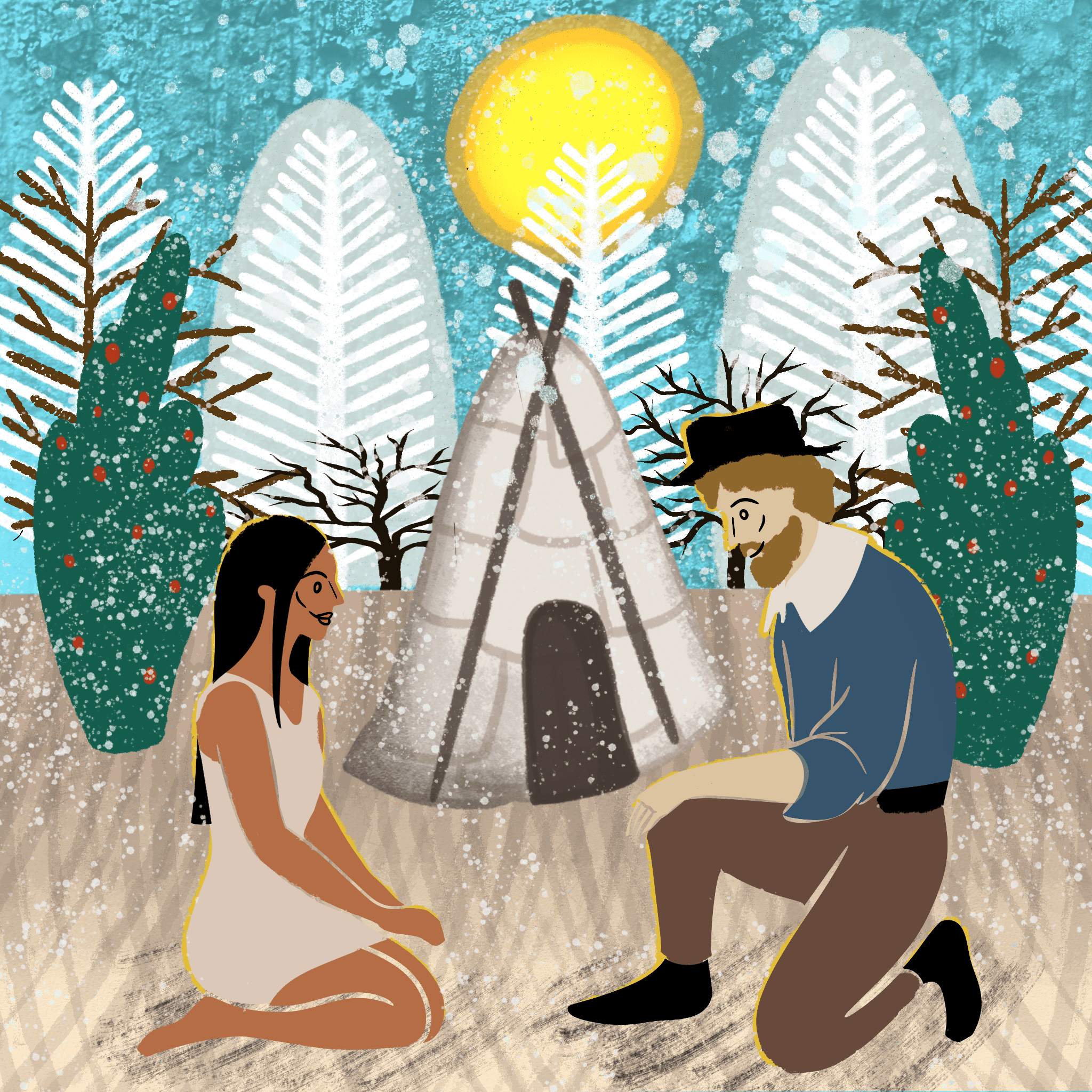
Pocahontas throws herself upon the bent head of John Smith, saving his life.
IN THE SPRING OF 1607, three ships landed on the shores of what is now America. About 100 men – no women were asked to come – stepped onto the sand to start a new life.
The men built 20 cabins and a fort to surround and protect the cabins. They called their new town Jamestown. But they were not the only ones living on that land.
Up and down the coast and for miles into the woods lived tribes of Native Americans. This is the land that is now called Virginia.
Back then, it was called the Powhatan Confederacy. One chief ruled over 30 tribes in the Powhatan Confederacy, and his name was Powhatan.
Chief Powhatan’s scouts told him that ships had landed on shore, and new men had built a fort and cabins. They told him the new men spoke in words no one had ever heard before. They wore clothes no one had ever seen before.
What Powhatan wanted to know most of all was, where did these strangers come from? Why were they here? What did they intend to do? And how would he become their Chief?
His scouts told him other news too, that was most odd. They had planted no crops around the fort. No canoes were anywhere near the fort, and the men did not even stand by the river to fish. The men did not go into the woods to hunt, either. They had no arrows and bows. Thought Powhatan, “These men do not know how to plant, ride a canoe, fish or hunt. It will be easier than I thought to be their Chief.”
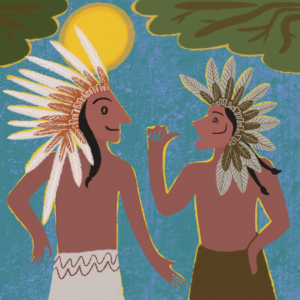
“We will bring food to them – corn, beans and squash. Without us, they will starve. Then I, Powhatan, who rules 30 tribes, will rule over them, too!”
“Father let me come with you!” said Powhatan’s daughter Pocahontas. No one had seen her slip into the longhouse. “I want to see the fort, too.”
“Surely not!” said her father. “You have work to do here. When you are done, you may play with your sisters.”
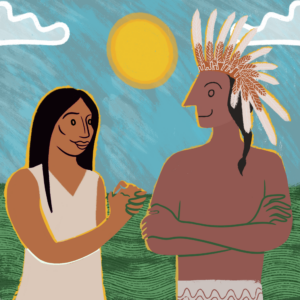
“I play with them every day!” said Pocahontas. “Father please, let me come with you!” Powhatan smiled.
“Ah, my princess,” he said. “How can I say no to that face?” Pocahontas beamed. At long last, an adventure! She felt sure that if she had to sew one more moccasin, or fill one more basket with berries, she would burst! So Chief Powhatan, leading a number of scouts carrying baskets of corn, beans and squash, and with Pocahontas beside them, all went to the fort.
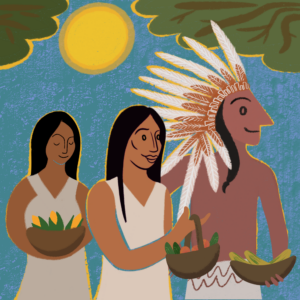
When they got there, they set down the baskets and stepped back. In a minute, the men of Jamestown in their odd clothes and speaking their odd language came out of the fort to greet the visitors with smiles. The gift was accepted. Pocahontas saw something else that made her smile, too. Boys a bit older than she also came out with the men of Jamestown. She waved to the boys, and they waved back. When the adults were trying to talk to each other using their arms and hands, she said to them, “Want to play?”

They did not understand her words. But soon they were showing her how to play tag and stickball. And she was showing them how to do cartwheels. After a while, Powhatan called, “Pocahontas! It’s time to go.” Every four or five days after that, Pocahontas came back with the others to the fort. Each time, Powhatan’s scouts carried corn, squash, and beans. Sometimes for a special treat – maple sugar, too. Pocahontas learned the names of her new friends – James, Nathaniel, Richard and Samuel. And they learned her name. She also learned the name of their leader, John Smith.
The days became shorter and the rain stopped coming. The corn in the fields dried up. The squash and the beans on the vine dried up. Berries on the bushes dried up. “We cannot take food to the fort anymore,” said Powhatan. “We need to save all we have so our people will make it through the winter. We must go to the fort and tell them.”

When the men in the fort understood the news, they got angry. They marched into their cabins. They came out with guns, and shot the guns into the sky. Powhatan got angry, too. He said, “I warn you, white men! Do not go anywhere near our village! If you do, you will be sorry!” The men of Jamestown could not understand what Powhatan was saying. But they could tell from his face that they were no longer friends.
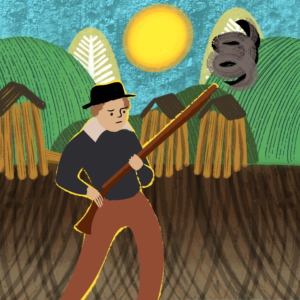
Some time after that, John Smith was going through the woods looking for food. He was close to the village of Powhatan – too close. Powhatan’s brother and some of the tribe saw him pass. In a flash, they jumped out at him. They held John Smith down to the ground and took him back to Powhatan’s village. “Now it will be done, once and for all,” said Powhatan. “I will be Chief to all the people in the fort.”
That winter, John Smith could not leave Powhatan’s village. Still, the Native Americans made him feel as comfortable as a prisoner can be. Pocahontas also spent time with him. Day after day, they would teach each other the language that each other’s people spoke.
As the snow melted, the people of Powhatan’s village started to get ready for a celebration. Powhatan called John Smith into his longhouse. “The festival will soon be here,” he said.
As the snow melted, the people of Powhatan’s village started to get ready for a celebration.
“What festival?” said John Smith. Now he could better understand what Powhatan was saying.
“The festival to mark the time when your people join my people. When I become your Chief.”
“That will never happen!” said John Smith, scowling. Powhatan did not know the words the young man was saying. But the Chief could tell that John Smith was angry.
“Your people have no choice!” said Powhatan. “If you will not join my tribe, you must die!”
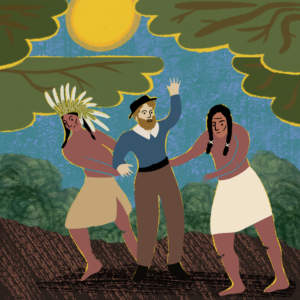
No one saw Pocahontas slip into the longhouse. Powhatan said: “Put his head on the rock!” Two strong braves grabbed John Smith and pushed his head down on a rock. Powhatan lifted a large rock above him, ready to strike. “No!” the girl cried out. All of a sudden, Pocahontas rushed up and bent over John Smith, placing her own head over his.
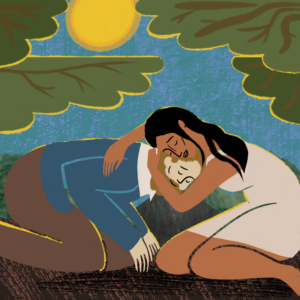
Powhatan held the rock high in the air. “Pocahontas!” he cried out. “Move away!” “I will not move!” she said, turning her head to the side. “Let him be. Let all of them be!” Powhatan held up the rock. Then, he lowered his arms. “My daughter,” he said in a soft voice. “You are right. One harm causes another.”
Powhatan set John Smith free. Powhatan’s tribes brought food again to the men in the fort, this time smoked meat and fish.
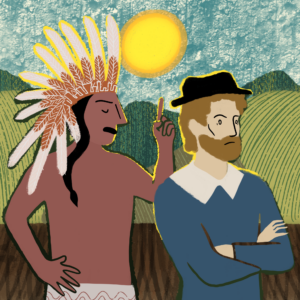
In return, the men in the fort gave them glass beads and copper. Now the moccasins sewn by Powhatan’s people were decorated more beautifully than ever. Both sides traded what they could, and each was the better for it.
Discussion Questions:
Question 1: Choose one character. How did that person or animal change/grow/learn by the end of the story?
Question 2: Say what you think the story is trying to show you.

Source:
Pocahontas by Simon van de Passe, (1595 – 1647.) publisher: William Richardson (1793)
Retold by Elaine Lindy ©2015. All rights reserved.
Footnote:
Some historians believe that Pocahontas was about ten when John Smith came to America. Others as well as Disney, portray her as a young adult to blossom a love story among herself and John Smith. In our version, we leave it up to the reader. Other historians believe Smith relayed what he thought he experienced, but in fact he had misinterpreted events and Powhatan’s tribe was honoring him with a ceremony to welcome him to the tribe. The version of the Pocahontas tale told above draws from both interpretations as well as from other credible historical and contemporary accounts. The ultimate fate of the Powhatan Confederacy was defeat. However, there were periods of peace, and the end of this tale leads to one of them.
The story of Pocahontas and John Smith comes from the writings of John Smith and other Englishmen. Smith’s account of the story evolved over time, and the truth of his claims is often disputed. In 1616, Smith wrote a letter to Queen Anne that included the story of Pocahontas saving his life. In 1624, he published The Generall Historie of Virginia, which included the story of Pocahontas saving his life twice. Smith also wrote about a time he was saved by a Turkish princess in a very similar way, leading historians to wonder – did Smith make up both stories? However period writings confirm that Pocahontas befriended Smith and the colonists, that she often went to the settlement and played games with the boys there, and that she and her attendants brought provisions to the colonists who were often close to starving, and quite possibly saved their lives.
In 1907, Pocahontas was the first Native American to be honored on a U.S. stamp.