The Water Spirit of the Lake
The people of the floating islands panic as they watch their great lake sink.
Long ago, on the sparkling blue waters of Lake Titicaca—high in the mountains of what
is now Bolivia and Peru—there lived a boy named Isodoro. His people, the Uros, had a home like
no other. They did not live on solid ground, but on floating islands they built themselves
from tall totora reeds.
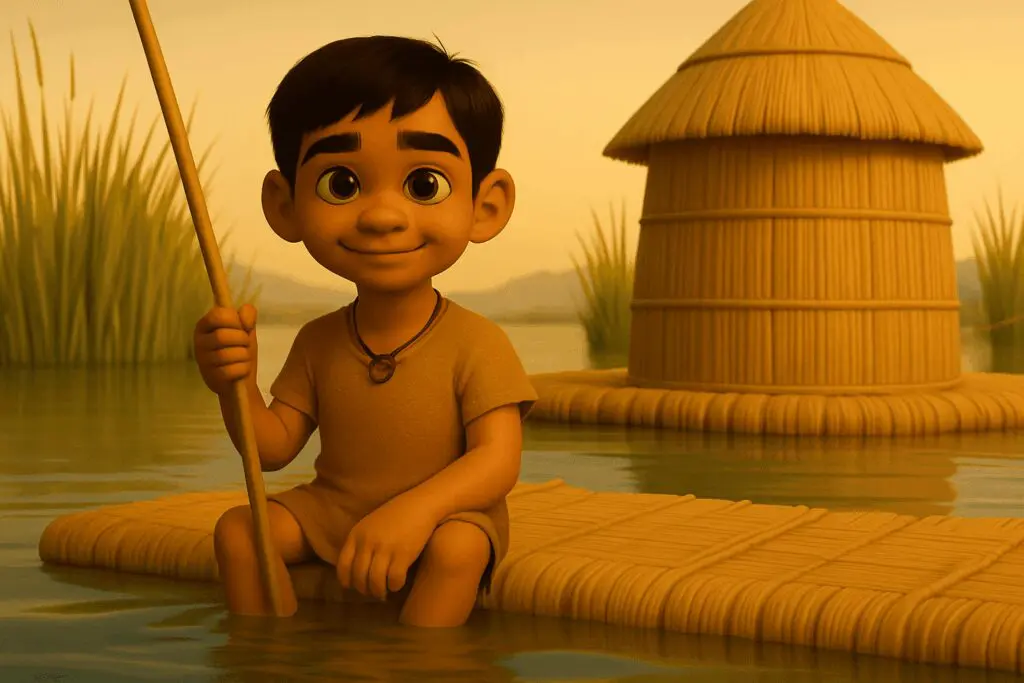
The Uros pulled the reeds from the lakebed, tied them into thick bundles, and stacked
them layer upon layer until they formed broad platforms. They were sturdy
platforms—strong enough to hold houses and even entire villages. More than a hundred
of these islands were tied together with braided reed ropes in the middle of the great
Lake, rocking with the waves.
They were sturdy platforms—strong enough to hold houses and even entire villages.
Until recently, the Uros had lived a wonderful life on the Lake. But a new danger was
looming, one that threatened the entire community.
For the water level of Lake Titicaca was dropping fast. In places, the tips of the totora
reeds now stuck out of the shallows, where they had always been hidden beneath the
water. If the Lake kept sinking, the islands might rest on the bottom of the Lake.
Long ago, the Uros built their floating homes to escape the shore people on the
mainland who often fought with them. Who knew what would happen if the shore people
could reach them over land?
One morning, the elders of the village called Isodoro and the other young men to go out
on their reed boats and measure how shallow the Lake was becoming.
The sky began clear and bright, but soon dark clouds rolled in, and the wind picked up.
Thunder rumbled in the distance. Isodoro quickly turned his boat back toward the island,
racing to beat the storm.
Then a sharp cry – a girl’s voice. He scanned the water.
Then a sharp cry – a girl’s voice. He scanned the water.
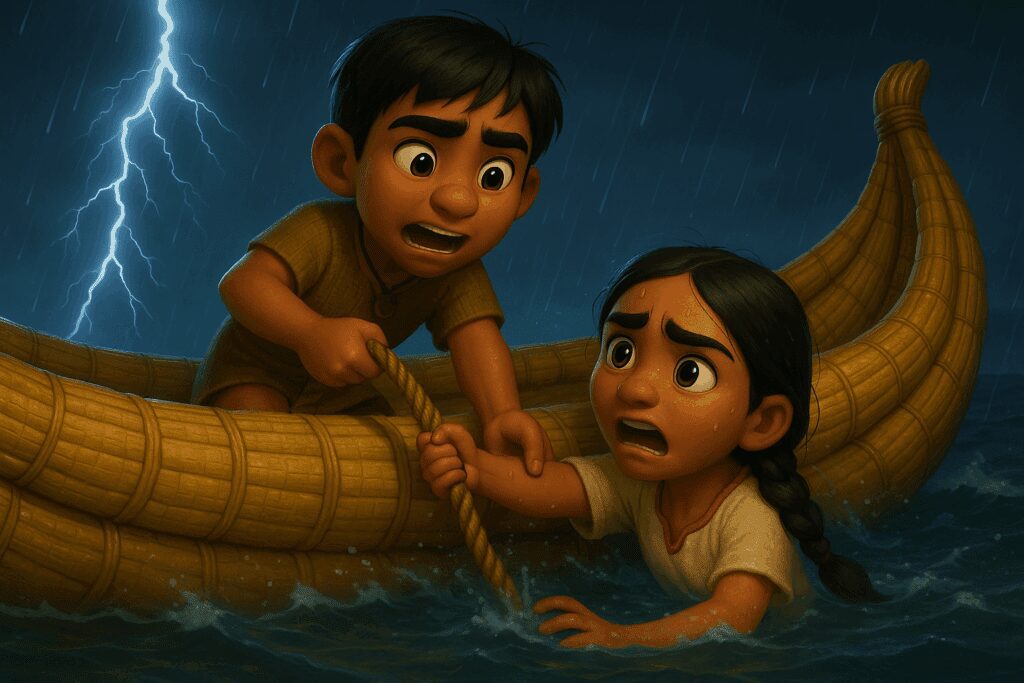
There, in the distance, a reed canoe had capsized. A dark head bobbed in the waves.
Isodoro grabbed a rope and pulled the girl to safety. She collapsed into the boat,
gasping and shivering.
She collapsed into the boat, gasping and shivering.
“You’re from the shore people,” he said, recognizing the style of her embroidered skirt.
“Yes,” she said, her voice shaky. “My name’s Aruma. But I can’t go back there. I ran
away from home to join your floating islands. I couldn’t bear it another minute! My
stepmother—”
She stopped. Isodoro looked grave. He knew a girl from the shore people would not be
welcome on the floating islands.
He knew a girl from the shore people would not be welcome on the floating islands.
“This may not work out,” Isodoro said slowly. “Everyone’s on edge these days because
the Lake keeps getting more shallow.”
“What do you mean?” said Aruma. “On the mainland, our rivers and lakes are full – the
water levels have never been higher.”
“How can that be?” said Isodoro.
“There’s only one way the Lake can be sinking when all the other waters are high,” said
the girl. “The Jichi, the great water spirit, must be upset. He must be draining water away
from the Lake.”
He must be draining water away from the Lake.
“Why would the Jichi be upset with us?” said Isodoro. “We’ve always respected the
Lake. We’re careful when we harvest the totora reeds, and we never take more fish
than we need.”
“Still,” Aruma murmured, “something must be bothering him.”
“Well, we’d better fetch your canoe before it’s lost and get back to the floating islands
before this storm gets worse.” He added, “I’ll ask the elders about you, but no
promises.”
“I’ll ask the elders about you, but no promises.”
Back home, Isodoro settled Aruma in one of the older, cone-shaped huts, fetched her
some cooked fish, then hurried back to his family’s hut before the storm arrived in full
force.
The next day, at Isodoro’s father’s request, the village elders met in a council.
“She cannot stay here!” declared the chief elder, pounding his walking stick on the reed
ground.
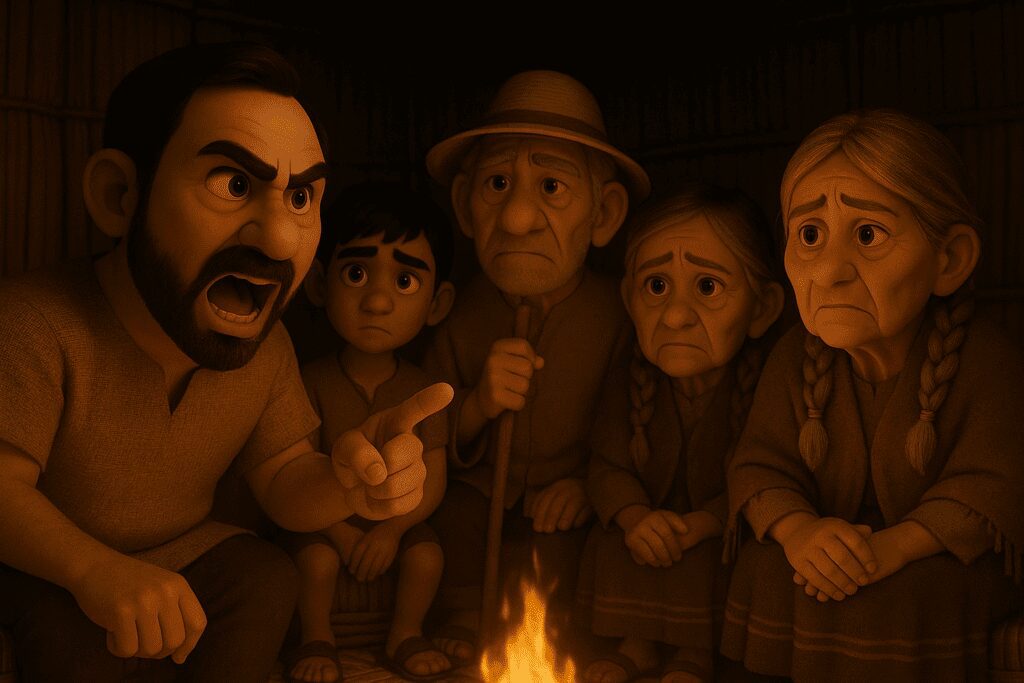
“She’s a spy from the shore people!” added another.
“With respect, honored elders,” said Isodoro, “I don’t think she’s a spy.”
“That’s exactly what spies would have you think!” the elder snapped back.
An elderly woman shook her head. “We have our own troubles to worry about. Look
how much the Lake sank just in the last few days – the totora reeds are nearly an
arm’s-length above the water now!”
“Isodoro, you must take that girl back,” the first elder said sternly.
“Isodoro, you must take that girl back,” the first elder said sternly.
“Make it today, son,” said his father.
When Isodoro approached the cone-shaped hut where Aruma had spent the night, she
could tell from his face that the news was not good.
“But I figured out why the Lake is sinking!” she blurted out.
“How could you possibly know that?” Isodoro asked, surprised.
“The cattle?”
Years ago, his people had grown tired of eating only fish and water birds. They took a
cow and bull from the shore people – after all, they had so much cattle there on the
mainland. Since then, the animals had multiplied, and now several dozen cattle lived
on the floating islands.
“Each cow drinks as much water as 50 people,” said Aruma. “And they foul the Lake’s
waters. More than anything, the Jichi water spirit protects the cleanliness of the water.
I’m sure that the Jichi does not like that your cattle are polluting this Lake.”
“How could you possibly know what the Jichi is thinking?”
“How could you possibly know what the Jichi is thinking?”
“If you don’t believe me, ask him!” said Aruma. “If we bring an offering to show respect
– three jars of chicha corn – then when you ask he might listen, and tell you.”
“No one even knows where the Jichi lives,” said Isodoro.
“I do,” said Aruma.
“You would take me there?”
“I would,” she said.
“But is it safe for me to travel there? Your people would attack if they saw my boat.”
Then a dark thought occurred to him: “She could be leading me into a trap!”
“I’m not!” she said hotly. “Are you telling me you wouldn’t come with me to see the Jichi,
even if learning the truth could save your people and the islands?”
Isodoro hesitated. What harm could it do to visit the great water spirit and find out if
anything was amiss?
While Isodoro gathered the three jars of chica corn needed for the offering, Aruma
looked near the hut, realizing it was likely her last day on the charming floating islands.
Near the reed watchtower, she noticed with delight a collection of miniature
dollhouses made entirely of totora reeds, complete with tiny reed people—unpainted
and beautifully crafted.
…unpainted and beautifully crafted.
“I wish I had something like this,” she mused, and a sharp pang tugged her heart as she
remembered her stepmother’s beatings, harsh rules, and endless chores.
The sun was setting when Isodoro returned with the three jars of chica. “Can you
navigate the boat at night?” he said.
“Of course!” said Aruma.
Guided by the moon and the stars, the girl traced a winding path through the mist.
Darkness fell. Hours passed. The wind grew heavy.
Guided by the moon and the stars, the girl traced a winding path through the mist.
Finally, the boat nosed into a narrow inlet. Then the trees parted to reveal another vast,
dark Lake.
Gently placing the three jars near the shore, Aruma called out, “Great and powerful
Jichi, please hear our cry!”
The surface of the Lake began to ripple. In the distance, a long, slithering figure snaked
its way closer to shore. A massive serpent’s head rose from the Lake. Jichi!
The water spirit fixed its gaze down on the two young visitors.
“Ask him!” Aruma whispered urgently, nudging Isodoro’s arm.
“Great Jichi?” said Isodoro.
“WHO are YOU?” roared the giant water snake.
“If you please, I’m Isodoro from the floating islands. Can you tell me why Lake Titicaca
is sinking?”
“Can YOU tell ME why your people brought CATTLE onto the islands?” hissed the
Jichi. “How DARE you pollute my crystal clear waters!”
“How DARE you pollute my crystal clear waters!”
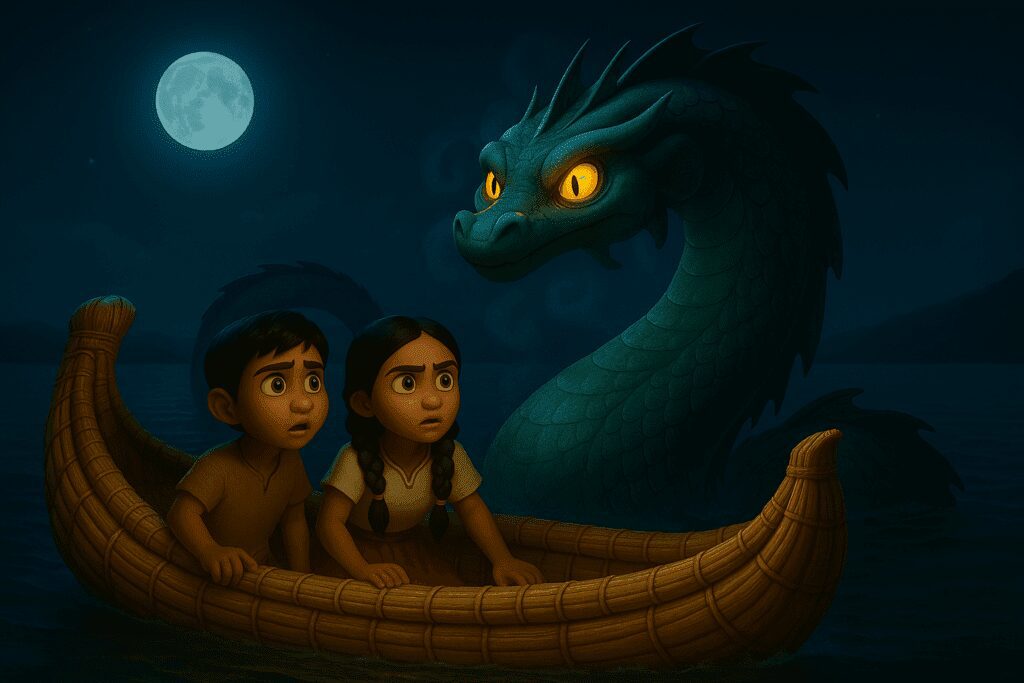
Aruma shot Isodoro a look that said: “I told you so!”
“Great spirit,” said Isodoro, “if we return all the cattle to the mainland, will you restore
Lake Titicaca to the level it was before?”
“If you do NOT,” boomed the Jichi, “there will BE no more Lake Titicaca!”
“But—” And here Isodoro hesitated. “If we tell them to do that, why would they believe
us?”
“You brought me an offering,” said the great Jichi, with clouds of mist swirling around its
head. “I will send them a sign. Now GO!”
“I will send them a sign. Now GO!”
By the time Isodoro and Aruma returned to the floating islands, the sun was rising low
on the horizon. The Uros people were pointing and talking desperately as they
compared notes of how the Lake dropped even more overnight.
Isodoro shared with the villagers what he and Aruma had learned from the Jichi, and
what the Uros people must do.
“What? There’s no way we’re giving up our cattle!” declared one of the elders.
“Two young people show up and tell us a far-fetched story,” agreed another, “and
we’re supposed to go along with it?”
Just then, fat raindrops began to fall that became a steady shower, and then a
downpour. Hours later when the villagers emerged from their huts, they were
astonished by what they saw.
“After a flash flood like that, the level of the Lake should go up—but look!” said one of
the elder women, pointing to the totora weeds that now reached nearly an arm’s-length
over the surface of the Lake. “The Lake only sank down even more!”
“This is a sign!” cried one villager.
“This is a sign!” cried one villager.
Another villager said skeptically, “How do we know this isn’t a fluke?”
“It’s not worth going against the Jichi!” shouted another.
Finally all the Uros villagers, even the elders, nodded in agreement.
“We have no choice!” said the leader of the elders. “We cannot ignore a message like
this.”
“If I may,” said Aruma. “My people would pay well for those beautiful dollhouses you
make from reeds. With what you earn, you could likely buy all the beef you want from
the shore people.”
“But the shore people will never purchase anything from us!” said one villager.
“They know me,” said Aruma. “And besides, you’d be returning all the cattle.”
“They know me,” said Aruma.
So at last, the Uros people brought all of their cattle back to the mainland. The shore
people were amazed—the two animals that had disappeared those years before had
multiplied into such a large herd!
From the crowd emerged an unexpected face. “Aruma – it’s you?”
She blinked. “Father?”
“When you disappeared, I searched everywhere. That’s when I found out how cruel
your stepmother had been. Of course I sent her away at once.” He opened his arms,
“Dear Aruma, can you ever forgive me? Please, come home!”
“Dear Aruma, can you ever forgive me?
They hugged just as the very last calf stepped onto the mainland. At that moment, a
light rain started to fall. The Uros returned home in the rain, and then came a steady
downpour, one that lasted for three days and three nights. The Lake’s waters rose and
rose until the totora reeds were completely covered again, and then some.
When the rain ended, a rainbow arced across the Lake, its colors reflected in the calm,
clear, fully replenished waters.
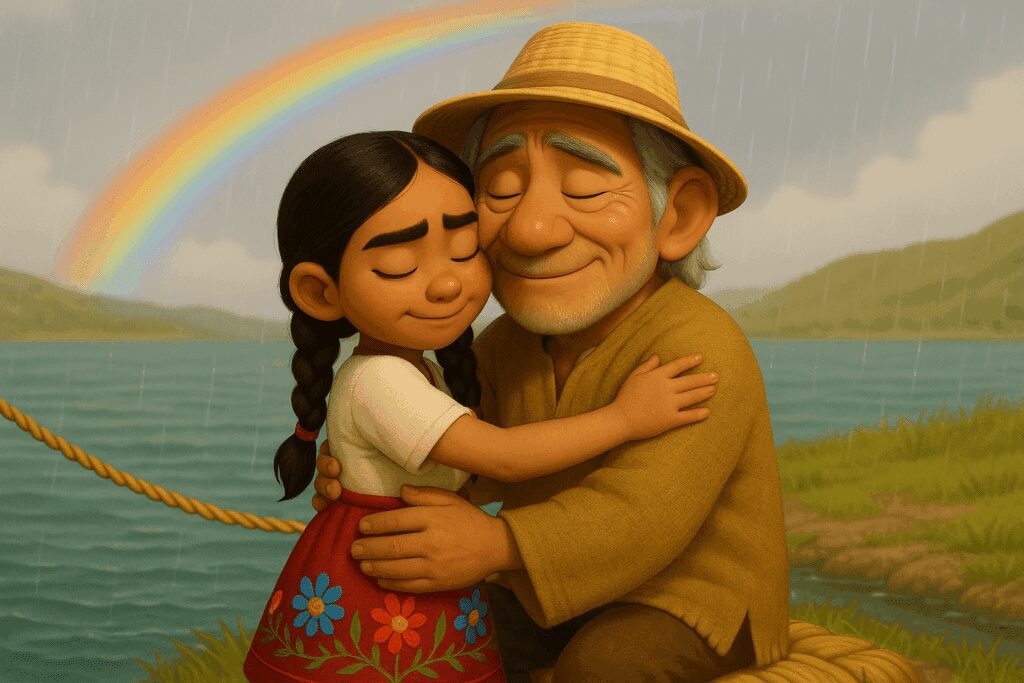
From that day on, the Uros and the Aymara lived in harmony, trading goods and stories.
And the enchanting miniature reed dollhouses crafted by the Uros people became
treasured far and wide.

Source:
Retold by World Stories Bank from an old Bolivian folk tale.
Adapted by World Stories Bank ©2025, all rights reserved.
Footnote:
Lake Titicaca is so high up in the mountains that if it were in Europe, it would sit above the tallest peaks in Switzerland and Austria! It’s also huge—more than twice the size of all their lakes put together. On the quiet Bolivian side, visitors can explore ancient Incan ruins, meet families who make colorful crafts, and hear stories that keep the lake’s history alive.